01
Audit how computers are used now.
Count the worksheets that were digitized, the "one and done" projects and the corner kiosks.
- Evidence
- Theory and Practice.
- Caveat
- Digitizing paper isn't harmful in itself. It just "maintains things as they are."
⚠ Experiment in progress. This site is being built by Bryan and his instantiation of Hark, as an experiment for some other decade or planet. Things here are provisional, recursive, and intentionally unfinished. The everyday Bryan lives at bryansanders.com →
Experimental · always changing
Dr. Bryan P. Sanders · Children, computers, and powerful ideas
“What can a human and a machine construct together that neither had fully specified before they began?”
Build it. Enter it. Notice what happened. Change it.
Bryan's ideas, built from Bryan's own writing. Every quote below comes word for word from one of his texts, and every source is linked or named. This is a working lab, not a peer-reviewed publication, and it grows as the work grows.
Dr. Bryan P. Sanders has spent more than two decades asking one question in different forms: what happens when the computer stops delivering school and starts helping learners build it? The ideas on this page come from his 2019 dissertation on Critical Techno Constructivism, his 2021 chapter Could Minecraft Be a School?, his 2022 essay on purposeful play, his 2025 essay introducing co-active emergence, and his current Sunshine Machine research on Persistent Computing Environments.
RE:EDUCATION, LLC
Who is Bryan Sanders? · Guiding principles
Dr. Bryan P. Sanders, bryansanders.com /teacher/
Turtle path
Card catalog · 14 drawers
Pedagogical experiments
01 · 1995
02 · 1995–2022
03 · Undated
04 · Mid-2010s

05 · 2016–present

06 · 2021–22
07 · 2023–24
08 · 2024
09 · 2024–26
10 · 2025–26
11 · 2023–25
12 · 2022–present
13 · 2026–
14 · 2026–
Order and years as listed in the TurtleBlock AI experiments timeline. The fantasy-league entry carries no year there.
Every quote is Bryan's own words as written, linked to its source. Unpublished drafts are labeled as such.
How to read the quotes. Text marked 2019 draft comes from a March 2019 working draft of the dissertation. The final, approved version is at LMU Digital Commons, and its wording and page numbers may differ. Page numbers given for Dewey, Freire and Papert belong to those authors' books, as Bryan annotated them in Chapter 4 of the draft.
A · Concept codebook
Each entry gives a plain definition, the dimensions that make up the concept, what counts and what doesn't, one anchor quote, and the year the idea first appears in Bryan's writing.
01 · First appears 2019
A learning theory for digital learning environments. It combines constructivism (learners make meaning by doing), connectivism (learning happens across networks of people and information) and critical theory (learners question power). Under CTC, students use computers to think, make and question, rather than having computers deliver predetermined answers to them.
"Using computers as the tools that we learn with, never at, this negotiated space encourages students to inquire deeply, question broadly, and fashion new ideas."
2019 draft, Ch. 3, "Propose New Learning Theory"
Dimensions
The 2019 draft lists seven precepts, each paired with a question a teacher can ask:
Current wording (TurtleBlock AI taxonomy): Personal Inquiry · Compelling Problem or Question · Technology as Tool to Think With · Formative Demonstration of Learning · Reflection as Learning · Social and Cultural Critique · Sharing and Collaborating.
Counts as
Doesn't count as
First appears
2019. The draft names it at the end of the Chapter 2 literature review: "Critical Techno Constructivism may be the correct name."
02 · First appears 2025
A way of working with generative AI in which humans and machines take part in an ongoing dialogue ("co-active"), and ideas and solutions develop out of that exchange ("emergence") instead of being set in advance. The human keeps judgment and authorship throughout.
"The newly coined term co-active emergence tries to describe a collaborative, interactive involvement (co-active) coupled with the natural development of ideas and solutions (emergence)."
GPT and Me, An Honest Reevaluation, Impacting Education 10(1), 2025, p. 96, doi.org/10.5195/ie.2025.479
Dimensions
Counts as
Doesn't count as
First appears
2025 in print. Working drafts are earlier.
03 · First appears 2026
A computing environment that can stay with a learner over time. It keeps questions, artifacts, revisions and conversations available so they can come back into later inquiry. It does this without taking ownership of where the learning goes next.
"what might happen if a computational environment could remain with a learner over time, preserving enough continuity to support inquiry without quietly taking ownership of it?"
The Sunshine Machine, opening section, working draft
Dimensions
Counts as
Doesn't count as
First appears
2026, in the Sunshine Machine and TurtleBlockAI working documents. Its roots run back through Minecraft (2021) and CTC (2019).
04 · First appears 2019
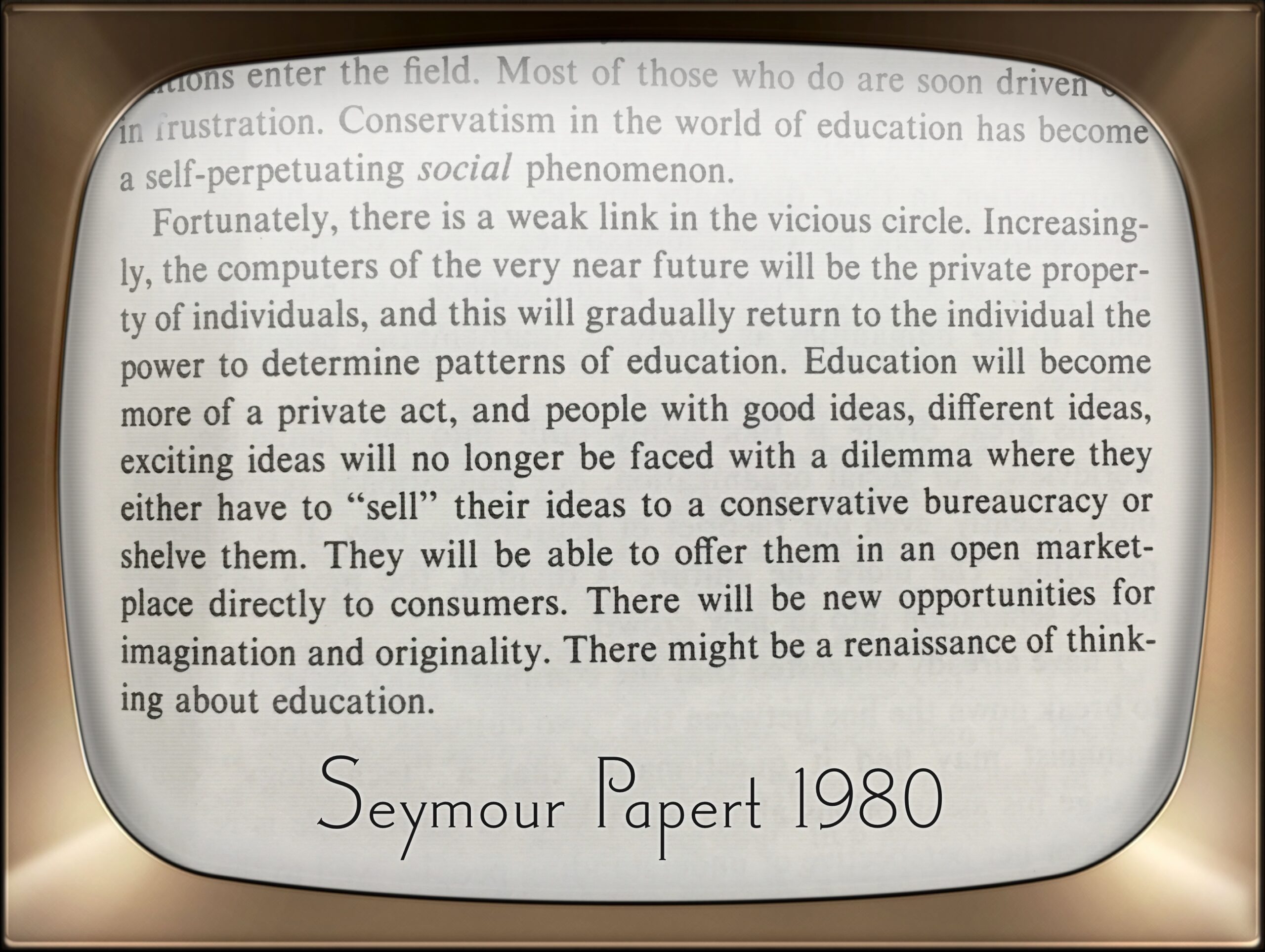
A microworld is a bounded but open space, on a computer or off it, where learners can experiment, build, share and debug. A powerful idea is one that "not only enhances understanding of complex concepts but also stimulates creative innovation" (microworlds works-in-progress proposal). Both concepts come from Seymour Papert's Mindstorms (1980).
"the work people do with computers creates microworlds of the world outside of the computer."
Could Minecraft Be a School?, 2021, §17.3, p. 389
Dimensions
Counts as
Turtle Geometry, block play, imaginary play, robotics and Minecraft, when students are engaging with ideas and connecting new concepts to what they already know.
Doesn't count as
First appears
2019 draft, through Bryan's annotations of Papert. It appears in his own argument by 2021. The microworlds proposal is undated.
05 · First appears 2021
Using Minecraft as the learning environment itself, "a way to think", rather than as a supplement or a room students visit, "a place to go". The curriculum grows out of students' play, questions and conflicts over long periods of time.
"the discussion of incorporating Minecraft receives a treatment that presents it more as a place to go instead of a way to think."
Could Minecraft Be a School?, 2021, §17.2, p. 388, doi.org/10.1007/978-3-030-75142-5_17
Dimensions
Counts as
Doesn't count as
First appears
2021.
06 · First appears 2022
Treating student play as serious learning. Students' own questions, prompted by a shared world, organize the work, and the teacher steps in "at relevant moments" with guidance, information, lessons and questions.
"Students and teachers enter a dialogue and co-construct the class curriculum."
Purposeful Play – Educating with Minecraft, Minecraft Education blog, August 22, 2022
Dimensions
Counts as
The redstone-and-fish-dock exchange in the essay. Students choose where to build a city, the teacher asks how it will be powered, and students raise their own question about keeping the fish population alive.
Doesn't count as
First appears
2022, the dated Minecraft Education version. An earlier MinecraftEdu-branded version exists.
B · Dewey · Freire · Papert
In the 2019 draft, Bryan carries out a critical interpretive document analysis of three books: Dewey's Democracy and Education (1916), Freire's Pedagogy of the Oppressed (1970) and Papert's Mindstorms (1980). The table summarizes each thinker's position as Bryan annotates it. Page numbers refer to those books as cited in the draft.
| Concept | Dewey (1916) | Freire (1970) | Papert (1980) |
|---|---|---|---|
| Learning / constructivism | Learning happens "through the intermediary of the environment" (p. 26). Growth is an end in itself, not preparation for something else (pp. 55–56). | Problem-posing replaces "banking". Content is "constituted and organized by the students' view of the world" (p. 109). | "Anything is easy if you can assimilate it to your collection of models" (p. vii). Debugging and "false theories" are how children really learn (pp. 101, 132–133). |
| Liberation / agency | Education should "liberate the young from reviving and retraversing the past" (p. 79). Rejects "externally imposed ends" (p. 117). | "Freedom is acquired by conquest, not by gift" (p. 47). Liberation comes through critical discovery and action. | Computers as "carriers of powerful ideas and of the seeds of cultural change" that can cross cultural barriers to science (p. 4). |
| Technology / tools | No computers, but schools need "agencies for doing, with tools and physical materials" (p. 44). Bryan's gloss: educational technology "is a series of pathways from multiple starting points to multiple ending points." | Says nothing about computers. Bryan applies Freire's critique to edtech: banking and "narration sickness" are "known pitfalls that have flagged Educational Technology." | The computer is "the Proteus of machines" (p. viii) and an "object-to-think-with" (p. 23). Against "inventing new gadgets to teach the same old stuff" (Papert, 1972, quoted in Ch. 2). |
| Role of teacher | "In such shared activity, the teacher is a learner, and the learner is, without knowing it, a teacher" (p. 167). | Resolve the teacher-student contradiction "so that both are simultaneously teachers and students" (pp. 72–73). "People teach each other, mediated by the world" (p. 80). | Teacher and learner engage in "a real intellectual collaboration," so "the teacher does not have to pretend not to know" (p. 115). |
All three reject learning as passive absorption. Bryan draws the line directly: Freire named "banking education", but "John Dewey wrote about it much earlier than Freire" (2019 draft, Ch. 4). All three put the learner's own activity, questions and world at the center, and all three make the teacher a co-learner.
Papert expects computers to cross cultural barriers. Bryan's critical-theory chapter warns that educational software has often treated "whiteness as the default", and that more hardware alone has widened the digital divide. A tool can open a world, and it can also carry the assumptions of the people who built it.
Dewey and Papert mostly describe how a person builds understanding. Freire frames learning as collective, political liberation.
Dewey calls reorganizing education "a slow work… piecemeal, a step at a time" (p. 144). For Freire, freedom is "acquired by conquest."
Dewey: "It is equally fatal to an aim to permit capricious or discontinuous action in the name of spontaneous self-expression" (p. 108).
"A behaviorist model does not preclude a student's self-driven inquiry, though it does not explicitly encourage it" (2019 draft, Ch. 2). The problem is building everything around it.
Papert called LOGO environments "too primitive, too limited by the technology of the 1970s. The role I hope they fill is that of a model" (pp. 181–182).
Papert's teacher "does not have to pretend not to know". In Minecraft, students' knowledge "far exceed[s] their teachers'", and that power shift may deter some educators (2021, §17.1).
Bryan takes Dewey's experience and growth, Papert's construction with computers and Freire's critique of power, and adds Siemens's connectivism. The result is a theory in which students use computers to pursue their own questions and to question the systems around them, and in which teachers treat what students produce as "marks of mastery in place of externally imposed outcomes" (2019 draft, Ch. 3).
In the draft's words: "These three theoretical approaches can function together to create a new Critical Techno Constructivism for future classrooms" (2019 draft, Ch. 2). Here "these three" means constructivism, connectivism and critical theory.
C · Minecraft as school

The 2021 chapter uses these terms but doesn't formally define them. The working definitions below are drawn from how the chapter uses each one.
Learning organized around the student's own interests, voice and purpose. The chapter places Minecraft in "a thoughtful and powerful subsection of constructivist learning that focuses on student-centered experiences with games and projects." Its opposite is lockstep, predetermined outcomes.
The students' questions set the curriculum. Bryan describes "a fully immersive gameplay approach that might follow student inquiry and choice to co-create the curricula." In this approach the questions arise through play, and the teacher helps pursue them.
Making things, with the microworld feedback cycle of build, share, take critique and debug. Bryan's sharpest line: schools "often hold hostage the most engaging and transformative projects in their planned curricula" and quarantine "student-led work in specialty courses."
A game environment used as the learning environment. Minecraft's creative (sandbox) and survival modes can both be modified.
Where they align. All four oppose planned curricula with predetermined outcomes.
Where they conflict. Game-based learning as most research describes it is "supplementary lessons or companion experiences". That is game-based but not inquiry-driven. Bryan names this split: Minecraft treated "more as a place to go instead of a way to think."
Boundary case. Survival mode has built-in game objectives. Bryan counts both modes as open enough to be modified, so a game's own goals don't by themselves make it teacher-predetermined.
| Source | Type | Population / context | Design | What it found, per Bryan's text |
|---|---|---|---|---|
| Harel & Papert (1990) Software design as a learning environment | Case study | Students learning traditional math material with Logo. Age and setting not stated. | Experimental group (Logo, interactive computer environment) vs. control group (traditional methods) | The experimental group scored higher on a classroom examination. Bryan notes that "Thirty years later... this remains an open question for some educators and policymakers." |
| Ming (2020) | Small study, conference proceedings | Year Five students learning probability (the age group comes from the reference title). Country not stated. | Pretest/posttest with Minecraft as an experiential intervention, plus a qualitative reflection component. Sample size not stated, but described as small. | Better performance on a paper-and-pencil test. Claims about confidence and curiosity are "tempered by the sample size." Bryan calls for large-scale replication "across continents." |
| Baek, Min & Yun (2020) | Literature review | 28 articles (2012–2019) from the ProQuest database on Minecraft in education | Review | Most articles focus on elementary school, language arts, and playing the game rather than building or modifying it. "significantly more qualitative than quantitative studies." Use tends to be supplementary. Time and "curriculum inflexibility" are barriers. Bryan's Table 17.1 summarizes the benefits and experiences it lists. |
| Xu, Chen, Eutsler, Geng & Kogut (2019) | Scoping review | 59 articles (2000–2018) on digital game-based learning for English language learning. Not specific to Minecraft. | Review | Nearly 80% reported a positive impact on English language acquisition. About 75% had samples under 100. Recommends standardized tests aligned with commercial games. Bryan reads this as favoring traditional measurement. |
| Lane & Yi (2017) | Book chapter (conceptual) | Minecraft as a learning environment | Not an empirical study | Ties Minecraft to Papert's constructionism: knowledge "constructed by learners rather than simply being told." |
| Stager & Martinez (2019) Invent to Learn | Book (practitioner) | Making and tinkering classrooms | Not an empirical study | "quality work takes time, disobeys bell schedules... might not have any impact on test scores." |
| NAEP (2020) | National assessment data | U.S. students at grades 4, 8 and 12 | Not stated | Score gains since 1992 are slight and not sustained. Bryan uses this as context for why standardized approaches have not shown their worth. |
Comparatively well studied: elementary grades, language arts, playing (rather than building or modding), qualitative accounts, and Minecraft as a supplement to planned lessons.
D · Practitioner guides
Each step carries a note on how strong the evidence behind it is and a caveat.
Evidence labels used below
01
Count the worksheets that were digitized, the "one and done" projects and the corner kiosks.
02
Swap an externally imposed outcome for one students shape.
03
Use the first CTC question: Did the student develop the learning task?
04
Programming, building, modeling and mapping, rather than quizzes.
05
Ask "How can I fix it?" instead of "right or wrong".
06
Look for learning throughout the process, not only at the end.
07
Students explain how their thinking changed.
08
Ask whose voices, defaults and assumptions are built into the software and the topic.
09
10
Use the CTC questions as a self-review rubric, not a scorecard.
This guide is drawn from a theory-building dissertation (document analysis), not from a classroom trial. It should be reviewed by practicing teachers and an educational researcher before it is used as formal professional development.
01
Drop students into a new world and let them explore and learn from each other.
02
03
Note what students ask, about mechanics and about values.
04
Add guidance, information, a short lesson or your own question, as in the redstone example.
05
Classes that "tracked their ideas and questions" find new things to explore.
06
Move questions into reading, writing, math and science work outside the game, then bring them back in.
07
Scatter readings through the game, and let debates grow from real decisions, such as building too close to a classmate.
08
Rebuild together and practice restorative communication.
09
An hour a week "goes so quickly it will not be a terribly productive or meaningful experience."
10
Bryan suggests asking your principal for a self-study of students working together in Minecraft.
The benefits listed in reviews (Baek et al., 2020) are mostly from qualitative studies, elementary school and language arts, and the only cited outcome gain on a test (Ming, 2020) comes from a small study. Full Minecraft as school has not been tested.
These are preliminary themes from interviews in progress, and the note calls itself an "early attempt to brainstorm." They are not study findings.
01
Interviewees raised compressed time schedules, worry about "walking away" from the volunteer site, and doubts about how the site connects to the course, the program and their dissertation.
02
Interviewees valued more space and time to practice transformative leadership, engaging with communities "in real space and time", and the chance to create change.
03
The note proposes "a few units throughout the three years" focused solely on a community-based learning project, rather than a single course.
04
As students start forming research questions and literature reviews, teach them to network across the university, the alumni database and their local communities.
05
These people can guide the dissertation and become entry points to a volunteer project.
06
Address the relevance concern directly, so the community project and the research inform each other.
07
Aim for projects that can "last through graduation and beyond."
08
Let doctoral students lead the choice and shape of their community work as part of the program's arc.
This guide is a starting point for discussion. It should be checked against the completed study and any published version before anyone treats it as a recommendation.
E · Open questions
These are from Bryan's working list for "The Sunshine Machine, a dissertation continued," quoted verbatim.
F
Built in public
Constructivist AI agents for building, exploring, and iterating computational worlds in Minecraft and beyond.
TURTLE LOOP · TURTLE_CHARTER.md
THINK → TALK → REPRESENT → CONSTRUCT → ENTER WORLD → NOTICE / TEST / BREAK / QUESTION → REFLECT → REVISE / FORK / RESTORE / LEAVE UNRESOLVED ↺
Research Library
Turtle notebook
Provisional machine interpretation · written by Hark from Bryan's writing · disagreement is data
The Experimental Classroom ran 1995–2022. In 2021 Minecraft was imagined as long collaborations, possibly over years. In 2026 it is named: the Persistent Computing Environment. The through-line may be continuity that a learner, not the machine, owns.
In 2019 it asked whose defaults live in the software. By 2026 it asks who controls memory, representation, retrieval, and forgetting. Same question, new machine.
STEAMHAMLET, recursive theater in Hot Tub Fever, The Klingon Hamlet on the shelf, and 'Make, Walk Around In, and Change the Story' all treat a story as a world you can enter and revise.
Next Edge: When Turtle shows why initiative is on hold, how can it expose the conflict without steering the learner toward one resolution?
X-factor: whoooo knooooowwwssssssssssss
Bibliography